
Home›Car accident claims›Three-car accident insurance
Three-Car Accidents: Whose Insurance Pays for the Damage?
When three vehicles collide, there may be two separate impacts and more than one claim. The driver at the back is not automatically responsible for every bit of damage, and being the middle car does not automatically mean you are to blame.
Find out how insurers investigate chain-reaction collisions, rear-end shunts and disputed impact sequences—and how to organise the evidence and vehicle-claim paperwork.
Responsibility is determined from the facts, applicable legal duties and evidence. Sterling can review qualifying vehicle-support requirements but cannot declare another motorist liable or guarantee insurance recovery.
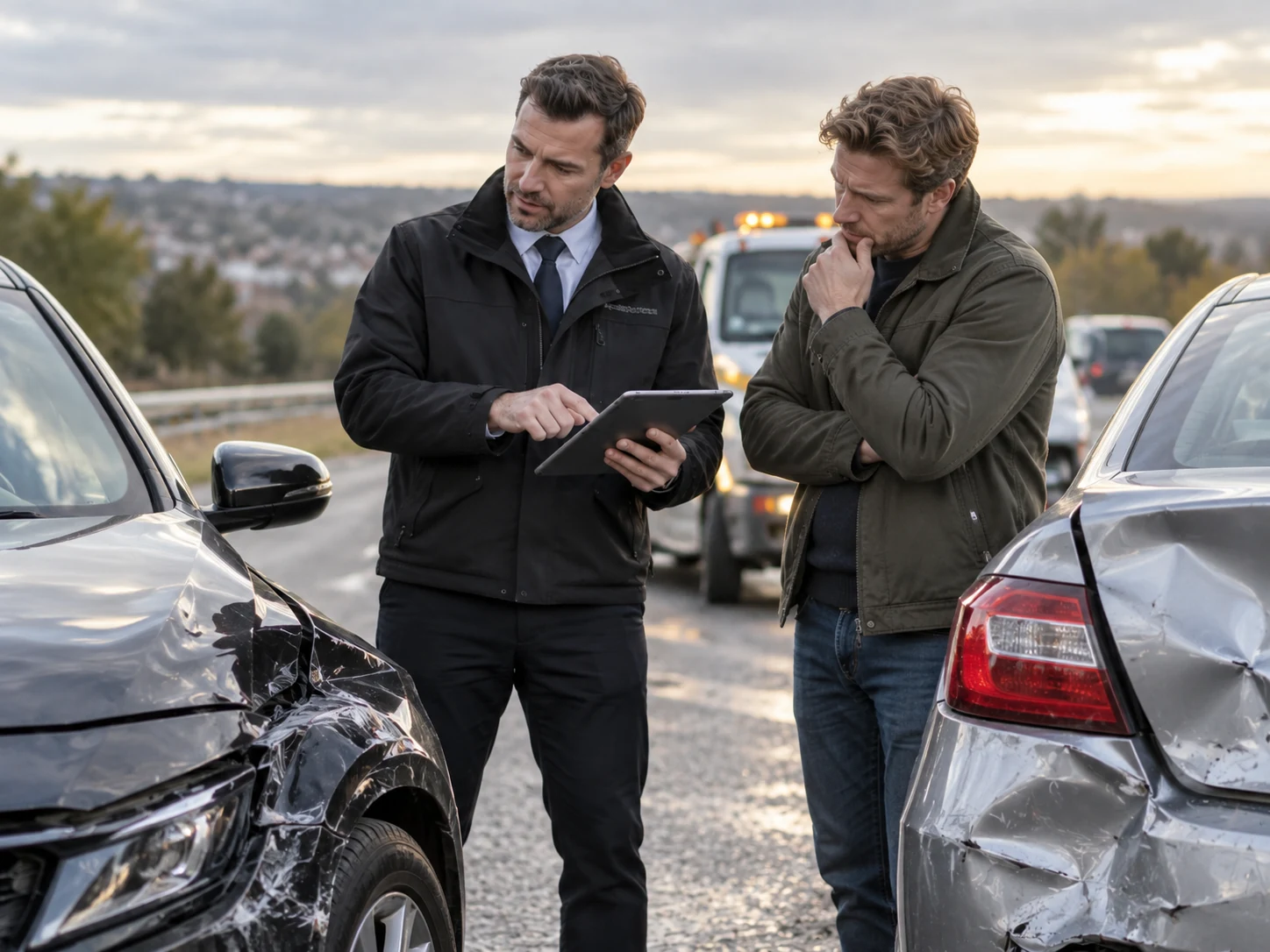
Who pays in a three-car accident depends on who caused each impact, not simply where the cars finished. A middle car pushed forward by a rear impact raises different questions from a middle driver who struck the front car first.
UK Highway Code Rule 126 advises motorists to keep enough distance to stop safely if traffic ahead slows suddenly. Insurers also examine driver accounts, independent footage, witnesses and engineers’ evidence before accepting or settling responsibility. The Financial Ombudsman explains how these decisions are reviewed when a policyholder disputes their insurer’s handling.
Two different three-car rear-end collision scenarios
For clarity, imagine three cars travelling in the same lane: A is at the front, B is in the middle, and C is behind. The arrangement looks identical in photographs after both impacts, but the order of events can change the liability assessment.
Has damage at the rear and may have slowed or stopped for traffic ahead.
May have both front and rear damage; the order of those impacts is important.
May be responsible for an initial rear impact, depending on stopping distance and other evidence.
Scenario 1: C hits B and pushes it into A
Car A has stopped. Car B is also stopped behind it, leaving a gap. Car C then collides with the back of B, and that force pushes B into A. If the evidence supports this sequence and no separate negligence is established for B, the claim against C may include the damage from both contacts.
However, it remains necessary to assess how the cars were positioned, whether B was actually stationary and whether the resulting damage is consistent with a single force-driven sequence. Being the middle vehicle is not proof of innocence by itself.
Scenario 2: B hits A first, and C then hits B
Car B follows A too closely and strikes A from behind. Shortly afterwards C collides with B. In this case, the first and second impacts may involve different potentially responsible drivers, and the damage caused by each event may need to be distinguished.
B may face a claim for the initial impact into A, while C may face a separate claim for damage it caused when it hit B. If C’s impact pushed B into A a second time, the additional damage and responsibility can be more complicated and may require expert assessment.
What if you felt two jolts? This can be useful evidence of two distinct impacts, but your description alone may not establish which vehicle moved first. Preserve original dashcam footage and independent witness accounts where available.
Whose insurance pays after a three-car accident?
Several insurance relationships may operate at once. Each driver should notify the insurer covering their own vehicle, and each insurer or appointed claims representative considers the available evidence, policy cover and liability. The person whose insurer initially pays for repairs is not always the person eventually considered legally responsible.
If you have comprehensive cover
Your insurer may arrange covered repairs or assess a total loss under your own policy, usually subject to the excess and other terms. It can then consider recovery from another responsible party or insurer.
If you claim against another driver
A third-party insurer may pay proven losses if its policyholder’s responsibility is accepted. That insurer can dispute the sequence, cause of damage, necessity of replacement transport or sums sought.
If the two impacts have different causes
The insurers may have to examine which car caused which damage. Some front or rear repair costs may relate to one impact, while other losses relate to another. A clear engineering explanation can help.
If liability remains disputed
Insurers may negotiate, agree a partial split or leave aspects unresolved pending evidence or proceedings. There is no fixed rule that three drivers share each bill equally.
Can a middle driver claim for front and rear damage?
Potentially, but the physical locations of damage do not automatically establish their cause. The middle car may have been pushed into the lead car, may have caused a separate initial collision, or both. Tell the assessor about the precise sequence and ask that both impacts are considered separately.
Does the front driver always claim from the rear driver’s insurer?
No. The front car’s driver may claim through their own comprehensive policy or against the party shown to have caused the relevant damage. In a two-impact accident, that party might be the middle driver, the rearmost driver or more than one responsible party depending on the facts.
For a general explanation of fault disagreements, see Sterling’s disputed-liability guidance. Do not agree to a private payment or admission without understanding the effect on your policy and other parties’ claims.
What evidence shows who caused a multi-car collision?
Because the cars may end up touching in a single line, a photograph of the final position can be misleading. Tell the claims handler what happened before each impact, including the position, speed and movement of each car as accurately as you can.
Evidence checklist for a chain collision
- Original dashcam footage: save front and rear camera files covering the lead-up and both impacts, not only a clipped impact video.
- First and second impact descriptions: note whether you were already stopped, whether you felt one impact or two, and the approximate order.
- Vehicle positions and gaps: record where each car was before contact, lane, traffic conditions and the distance between vehicles if known.
- Rear and front damage photographs: document relevant damage to all three vehicles from a safe location; include wider views if possible.
- Independent witnesses: gather contact details and what they actually saw, separately from their opinions about blame.
- Repairer and engineer findings: reports may help distinguish separate impacts, damage consistent with the sequence and pre-existing defects.
- Police and recovery records: keep any incident reference, road closure, vehicle recovery notes and insurer contact records.
Do not estimate exact speeds as facts unless you genuinely know them. If any of the cars has already been moved or recovered, explain the original position and why the final photographs may not show the impact sequence.
On a motorway or busy road, prioritise personal safety. Do not enter live traffic to take photographs or collect debris. Follow the Highway Code’s collision and motorway safety guidance.
Keep the actual footage, not just a screenshot. Original recordings may capture braking, vehicle movement and the time between impacts that a still image cannot show. Do not edit files to remove unfavourable or relevant information.
Five steps to make a three-car accident insurance claim
- 1
Check for injuries and make the scene safe
Stop, assess immediate danger, contact emergency services where needed and follow police instructions. Exchange legally required details when safe. Do not return to a vehicle on a dangerous carriageway just to gather evidence.
- 2
Collect the details of all three vehicles
Record each registration, driver and owner details where available, contact details, insurers and any independent witnesses. Note which vehicle was in front, middle and rear before impact.
- 3
Write a timeline of the separate impacts
Explain whether you were stationary or moving, the order of jolts and any evidence of a vehicle being pushed into another. Avoid making unsupported assumptions about who is legally liable.
- 4
Notify your insurer and preserve the evidence
Report the crash under your policy conditions, even if you intend to pursue a non-fault claim. Provide the original camera footage, photographs and recovery details, and ask for a claim reference.
- 5
Confirm repairs, liability and temporary transport
Ask who will assess damage, whether repairs require authorisation and which insurer or provider is handling the claim. Check any courtesy-car or separate hire costs and terms before agreeing.
GOV.UK explains the requirement to report accidents to your insurer even if you do not intend to claim. The Highway Code Rule 286 also sets out drivers’ duties to stop and exchange the specified details, and when police reporting is required.
Can three-car accident liability be split between drivers?
Yes, if the evidence supports responsibility by more than one driver or insurers negotiate an appropriate settlement. But there is no automatic 50/50 or one-third-each rule just because several vehicles were involved. Different drivers may be responsible for separate impacts or for different proportions of a loss.
If a dispute is unresolved, an insurer may make a commercial settlement decision after reviewing the available information. The Financial Ombudsman explains that most policies permit insurers to decide whether to accept liability and that it can review whether the decision was reasonable—not substitute itself for a court to decide the accident’s exact cause.
Will a three-car accident affect your no-claims bonus?
It may. An insurer can record a claim as “fault” for insurance administration if it cannot recover its costs, even where the policyholder disputes causing the accident. Any reduction depends on your policy and recovery position. A reported incident without an insurer payout should be treated differently from a paid claim.
To understand possible split settlements, see our 50/50 liability car insurance guide. For the distinction between blame and premium changes, read non-fault accidents and insurance premiums.
If the claim record looks wrong: ask your insurer to identify which impact it accepted responsibility for, what it paid or recovered and why it recorded the accident that way. Supply missing evidence and use the insurer’s complaints process if its handling seems unfair.
How Sterling can help after a three-vehicle accident
Sterling Accident can discuss the vehicle-management stages of an eligible case, including damage information, recovery for a non-driveable car, engineering assessment, authorised repairs and possible replacement transport while the vehicle is off the road.
In multi-car accidents, different parties may be handling the damage to different cars. Clear claim references, repair approvals and dates help avoid confusion. Sterling does not guarantee that another insurer will accept liability, pay a particular repair cost or fund credit-hire charges.
For the wider vehicle process, visit car accident claims, accident recovery and accident repair support.
Three-car accidents and insurance FAQs
Who is at fault in a three-car rear-end accident?
It depends on the sequence of impacts, following distances, driving behaviour and evidence. The rear driver is not automatically liable for every part of the collision, and a middle driver is not automatically responsible for damage at the front.
If I was rear-ended and pushed into the car in front, am I at fault?
If evidence shows your car was stationary or otherwise travelling safely and the rear impact alone propelled it into the car ahead, the rear driver’s responsibility may extend to the resulting contact. It is not automatic; the insurers must assess the actual circumstances.
What if I hit the front car before another car hit me?
That may involve two separate impacts with different potentially responsible drivers. Your initial impact into the front vehicle and the later collision into your rear may require separate liability and damage assessments.
Does the driver at the back always pay for a chain collision?
No. Following distance is important under Highway Code Rule 126, but liability cannot be decided solely from the final positions of the vehicles. The cause and order of impacts matter.
Can I claim for damage to both ends of my car?
Potentially. An engineer or claims handler may need to determine which contact caused each part of the damage and whether different insurers are responsible for different losses.
Should I contact all three insurers myself?
Report the accident to your own insurer and give the details of all other vehicles and drivers you have. Your insurer or appointed representative can explain who will handle each claim and whether further contact is needed.
Can insurers agree to split liability in a three-car accident?
Yes, where evidence or negotiations support shared responsibility. There is no rule dividing all claims into thirds or requiring an automatic 50/50 settlement.
Will a three-car accident count as a fault claim on my insurance?
That depends on the insurer’s payout, recovery and policy terms. “Fault” can mean that costs were not fully recovered rather than a court finding that you caused the accident. Ask for the recorded status and an explanation.
Been involved in a three-car collision?
Share the three vehicles’ details and the order of impacts as accurately as possible. Sterling can review the vehicle side of a qualifying accident case and discuss recovery, assessment, repairs and replacement mobility.