
Home›Car accident claims›Junction accident fault
Who Is at Fault in a Junction Car Accident?
Collisions at T-junctions, crossroads and side roads are not always straightforward. A driver may have ignored a give-way line, turned across oncoming traffic or pulled out because another vehicle appeared to be turning.
This guide explains the UK Highway Code rules, common junction collision scenarios and the evidence insurers use when drivers disagree about responsibility.
No single junction rule automatically decides liability in every accident. The road controls, what each person did and the available evidence all need to be considered.
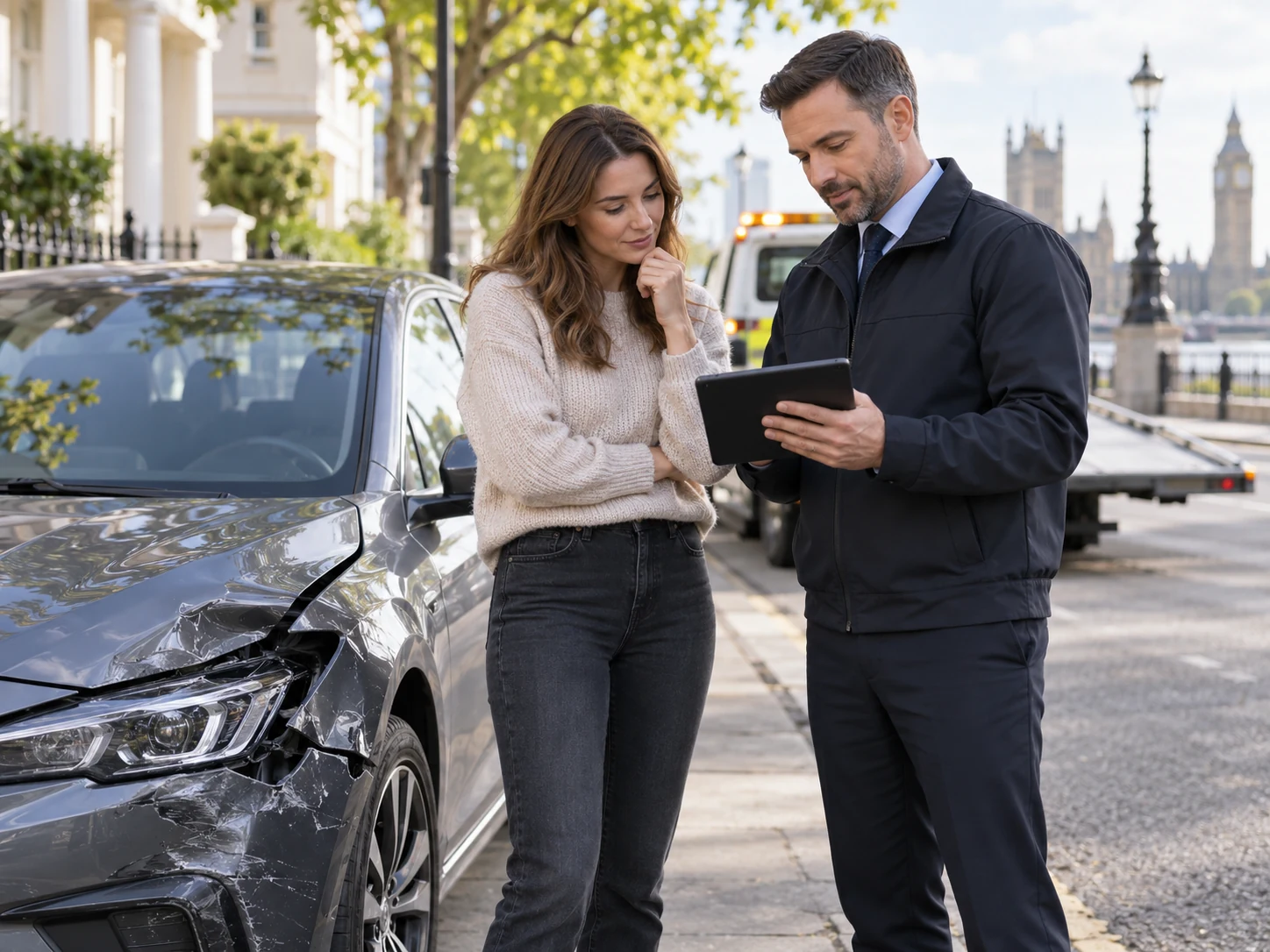
Who is at fault at a junction? It often turns on which driver failed to obey a relevant sign, give way, make appropriate observations or turn safely. However, a vehicle on the main road is not automatically blameless, and an insurance settlement may reflect disputed or shared responsibility.
The rules are set out in the Highway Code, Rules 170–183, alongside the rules on pedestrians, cyclists and the hierarchy of road users. The legal and insurance outcome depends on the actual junction and evidence.
What does the Highway Code say about junction accidents?
Highway Code junction rules cover the approach, road markings, turning manoeuvres and interaction with other road users. They help establish what careful driving requires but cannot by themselves prove every collision sequence.
Rule 170 — Observe carefully before emerging
At junctions, drivers should watch for pedestrians, motorcyclists, cyclists and other vulnerable road users. Do not assume another vehicle will turn just because its indicator is flashing. Look all around, and do not cross or join a road until there is a gap large enough to do so safely.
Rule 171 — Stop signs are mandatory
At a STOP sign with a solid white stop line, drivers must stop behind the line and wait for a safe gap before moving off. Rolling through a stop-controlled junction can be an important factor in a liability assessment.
Rule 172 — Give way at a side road
At a junction with broken give-way lines, emerging drivers must give way to traffic on the main road. The approach, road geometry and whether the driver emerged into the other’s path will be relevant if a crash occurs.
Rules 179–180 — Turning right across traffic
When turning right, drivers should wait for a safe gap in oncoming traffic, check for other road users and use the correct road position. A driver turning across an oncoming vehicle’s path may be responsible if the manoeuvre was unsafe; the other vehicle’s speed, signals and visibility may also matter.
Rules H2 and H3 — Pedestrians and cyclists
Drivers turning into or out of a junction should give way to pedestrians crossing or waiting to cross. Drivers also should not turn if doing so would cause cyclists going straight ahead to stop or swerve. Vulnerable road users need particular care, even where a motorist believes the route ahead is clear.
Unmarked crossroads are different from roundabouts. There is no universal UK rule that the vehicle coming from the right always has priority at an ordinary unmarked junction. Consider the signs, markings, road layout and safety of every movement.
Official sources: Rules 170–183, Rules H1–H3 and Rules 204–225.
Six junction accident situations and who may be responsible
Each scenario identifies issues to investigate, not a guaranteed insurance outcome. Collision fault depends on a complete account of what happened before the impact.
1. Car pulls out of a side road
Look at the give-way or stop controls, whether the emerging driver had a safe gap, available visibility and the speed and position of traffic on the main road.
2. Driver turns right across an approaching car
Relevant questions include the available gap, traffic lights if present, turning signals, road position and whether the oncoming vehicle could reasonably be seen and anticipated.
3. Two cars collide at an unmarked crossroads
No blanket “right-hand driver wins” rule applies. The approach speeds, observations, road layout, visibility and movements of each vehicle need to be reconstructed.
4. Driver emerges after seeing another car indicate left
An indicator is not proof that the vehicle will turn. Rule 170 warns against relying on another driver’s signal alone; the timing, direction and conduct of both vehicles still matter.
5. Vehicles collide at a traffic-light-controlled junction
Check signal sequence and lanes, whether anyone entered on red, right-turn phases, camera or independent witness evidence and whether vehicles were lawfully clearing the junction.
6. Car turns across a cyclist or pedestrian
The road-user hierarchy and turning priority rules are relevant. Consider cycle lanes, crossings, blind spots, sightlines and whether the turn caused another road user to stop or swerve.
If your collision involved a roundabout rather than a conventional junction, see our separate roundabout accident fault guide for Rules 184–190.
What evidence helps prove junction collision liability?
Photographs of damaged doors, bumpers and wings can help indicate the contact location, but impact damage alone rarely establishes the entire cause. Insurers often need to know where each car came from, the controls at the junction and what could be seen before either moved.
Evidence worth preserving
- Original dashcam footage: keep the approach to the junction, not just a clip of the instant of impact.
- Junction signs and markings: record STOP and give-way lines, turning arrows, traffic-light positions and any temporary restrictions.
- Vehicle positions: note the roads each vehicle approached from, intended directions, first point of contact and final positions.
- Independent witnesses: keep reliable contact details and separate what each person saw from what they inferred afterwards.
- Scene conditions: note lighting, weather, parked vehicles, visibility restrictions, roadworks and sightlines.
- Available CCTV: enquire promptly about possible recordings, which may be deleted or overwritten.
- Insurer, police and recovery records: retain correspondence, incident references and engineering information.
Take photographs only when safe. Do not step into moving traffic or obstruct the junction to record evidence. If injury or danger is involved, safety and emergency services come first.
One common mistake: do not automatically accept an insurer’s description such as “pulled out of the junction” if the video shows a more complex event. Provide the complete footage and a concise factual diagram instead.
How do insurers decide who was at fault at a junction?
Insurers compare the available driving accounts, independent witness reports, road markings, dashcam or CCTV and engineering evidence. They may accept one side’s liability, continue investigating, or agree to shared responsibility where the evidence or conduct of both drivers supports it.
The Financial Ombudsman Service explains that most motor policies allow insurers to decide whether to settle a claim. In complaints against an insurer, it considers whether that decision was reasonable on the evidence; it is not a court independently determining accident liability.
Can both drivers be partly responsible?
Yes, depending on the facts. For instance, one driver may have emerged from a give-way junction without a safe gap, while evidence of the other’s excessive approach speed or unsafe manoeuvre may also be material. That does not mean an automatic 50/50 split.
Our 50/50 liability car insurance guide explains how a shared settlement may affect recoverable claim costs, excess and no-claims records.
What if your insurer says you were responsible?
Ask what information it reviewed and whether it has the original footage and witness details. Correct any factual mistakes with documents, not speculation. Your policy may allow it to settle even if you disagree, but you can challenge unfair claims handling using the insurer’s complaints procedure.
Note that the administrative term “fault claim” can also mean an insurer has not recovered all its outlay, rather than a court deciding that the policyholder caused the junction accident.
Liability is different from practical vehicle help. Sterling can coordinate qualifying vehicle assessments, recovery, repairs and temporary mobility discussions. It cannot make binding decisions on which driver was legally at fault or guarantee claim recoverability.
Five steps to take after a junction car accident
- 1
Stop and make the scene safe
Check for injuries, call emergency services where needed and follow the legal duty to stop and exchange required details. Do not put yourself or other road users at risk.
- 2
Record the junction controls
When safe, note give-way or STOP signs, road arrows, traffic signals, the type of junction and the direction each vehicle was travelling.
- 3
Save your evidence immediately
Preserve original dashcam files, safe damage and scene photographs, witness contacts and the time and location. Make a factual diagram before memories fade.
- 4
Report the collision accurately
Notify your motor insurer as required by your policy, even if you do not plan to claim. Describe what you saw without guessing speeds or accepting a liability conclusion you cannot substantiate.
- 5
Ask about the assessment and vehicle route
Confirm who will investigate liability, authorise repairs, arrange recovery if needed and consider temporary mobility. Read the terms before agreeing to separate hire or repair charges.
For general reporting steps, see Sterling’s how to report a car accident guide and our disputed liability vehicle claims page.
Who is at fault at a junction? FAQs
Is the driver pulling out of a junction always at fault?
Not automatically, but the emerging driver normally has to comply with give-way or stop controls and choose a safe gap. The other driver’s actions and all relevant evidence may also be considered.
Who is at fault at a T-junction accident?
Look at the stop or give-way markings, whether the driver emerging from the side road did so safely, and the speed and conduct of the vehicles already using the main road.
Does traffic coming from the right always have priority at a crossroads?
No general right-hand priority rule applies to every UK crossroads. Signs, road markings, traffic controls and the conduct of each driver determine the relevant duties.
What if another car was indicating but did not turn?
Drivers should not assume a car will turn simply because its indicator flashes. The signal may be relevant, but observation, timing and whether it was safe to emerge remain important.
Who is responsible when a car turns right across traffic?
The right-turning driver should choose a safe gap and make adequate observations. The oncoming driver’s speed, signals, traffic controls and available evidence can also affect the decision.
Can junction accident liability be split 50/50?
It can be split when the circumstances or evidence support shared liability, including where claims are negotiated. But there is no automatic equal split simply because both drivers disagree.
Does dashcam footage prove who caused a junction collision?
It may be strong evidence where the relevant signs, movements, signals and timing are visible. It may not show all approach roads or blind spots, so other evidence can still matter.
What if my insurer wrongly blames me?
Ask for its evidence and reasons, give it any missing footage or reliable witnesses and request a review. If necessary, complain to your own insurer. The Financial Ombudsman may consider whether the insurer’s decision was fair on the available evidence.
Had a collision at a junction?
Tell Sterling what happened, where the vehicles were positioned and what condition your car is in. We can review the qualifying accident-vehicle route for recovery, assessments, repairs or replacement transport.